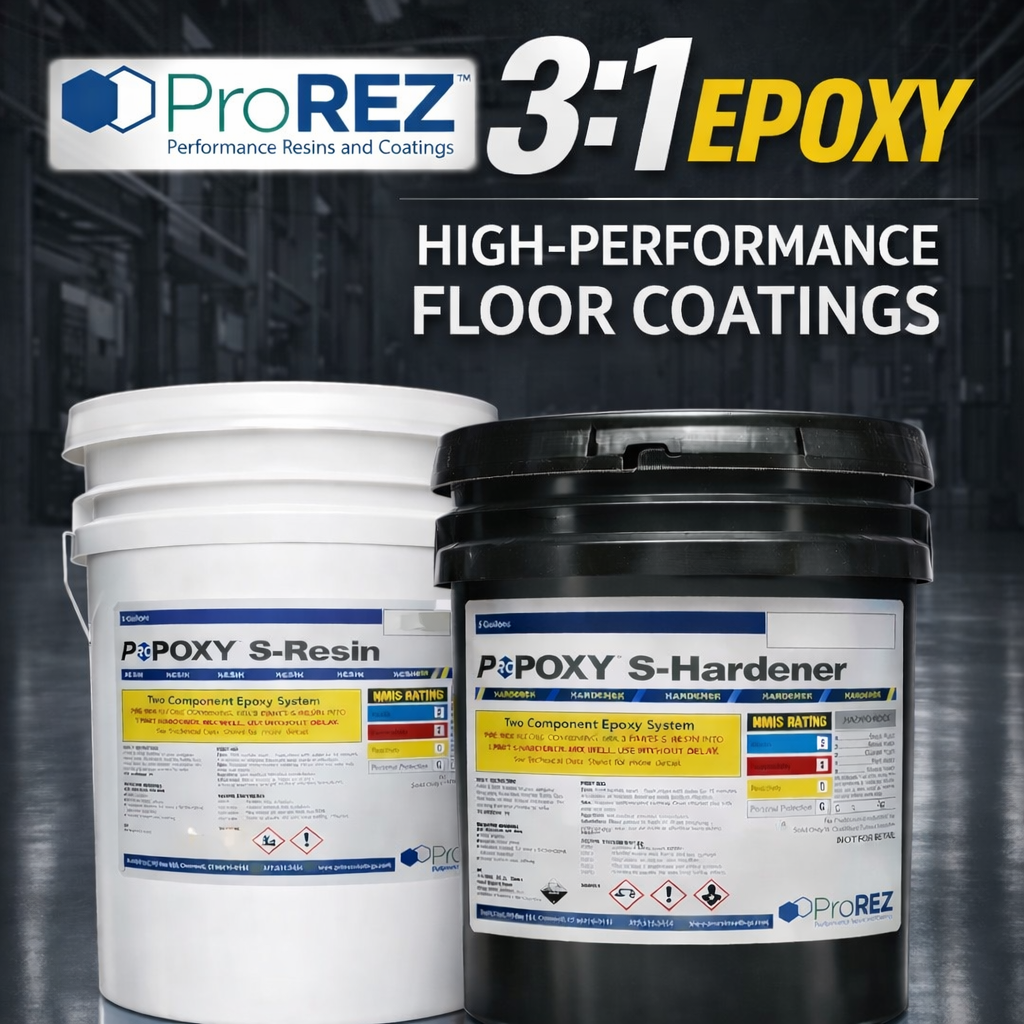
A coating system can look perfect on day one and still become a callback three months later if it was too brittle, too sensitive to job site conditions, or simply not engineered for real manufacturing environments. That’s why more contractors are moving away from “good enough” epoxies and toward true contractor-grade chemistry, specifically 3:1 – 100% solids epoxy like ProRez ProPoxy S.
This isn’t marketing fluff. It’s about what happens in the real world: heat, humidity, concrete variability, tight schedules, aggressive cleaning, forklift traffic, and the constant pressure to deliver floors that hold up.
Let’s break down why a 3:1-100% solids epoxy is a smarter system choice, and how that choice can directly increase your profitability.
What “3:1-100% Solids” Actually Means and Why It Matters
A 3:1 epoxy is formulated with more resin backbone relative to hardener. In simplified terms:
• The resin provides strength, chemical resistance, adhesion, and long-term durability
• The hardener controls cure and cross-linking
A 100% solids epoxy means there are no solvents evaporating out during cure. You’re putting down exactly what you paid for, and what you roll out is what stays on the floor. In epoxy chemistry, the “magic” happens during cross-linking. A 3:1 ratio allows for a tighter, more dense molecular structure. This results in a floor that is harder and more chemical resistant without being brittle.
Put those together and you get a coating engineered for:
• high-build performance
• consistent cure
• reliable film thickness
• industrial-level durability
That’s exactly what ProRez ProPoxy S is designed to do.
1) More Resin Backbone = Better Performance Under Real Abuse
The biggest reason contractors prefer 3:1 systems is simple:
More resin backbone per mixed gallon typically translates to a tougher, more chemically resistant film.
In demanding environments: aviation hangars, manufacturing, distribution, chemical processing, the floor isn’t just a surface. It’s a working component of the facility. It has to handle:
• harsh cleaners
• chemicals and oils
• constant traffic
• impact and abrasion
• heavy rolling loads
A contractor-grade 3:1 epoxy gives you a stronger foundation to build systems on top of, whether you’re doing a smooth epoxy, a broadcast, a mortar build, a decorative metallic, or a resurfacer.
2) Better Install Control: Longer Working Time and Product Consistency
Most jobsite problems don’t happen because the product is “bad.” They happen because the product is unforgiving.
A well-designed 3:1 epoxy like ProPoxy S typically offers a more controllable install experience:
• more predictable working time
• better flow and leveling
• less heat buildup (exotherm) in the bucket
• fewer surprises when temps change
That matters because your crew doesn’t get paid extra for fighting the material.
When the epoxy stays workable, flows clean, wets out evenly, and cures consistently, your installs are faster and your outcomes are more repeatable, which is exactly what you want when you’re scaling crews or running multiple jobs at once.
3) Reliable Film Build = Fewer Callbacks and Cleaner Warranties
With solvent-based or thin epoxies, you can “think” you applied enough material… until the solvent flashes off and you realize the film build isn’t what you expected.
With 100% solids, the build is far more honest:
• minimal shrinkage
• better edge hold
• consistent thickness
• better body for broadcast applications
That translates into fewer performance issues down the road, and fewer uncomfortable conversations with customers.
Callbacks don’t just cost materials, they cost:
• labor
• travel
• schedule disruption
• morale
• and the reputation that earns referrals
The best contractors don’t win by doing more work, they win by doing less rework.
4) More Forgiving Chemistry = Less Sensitivity to Jobsite Variables
Concrete is never perfect. Neither is weather. Neither is a fast-track schedule.
A big advantage of a contractor-grade 3:1 epoxy is that it’s generally less sensitive to small errors and jobsite swings than quicker, thinner, retail-style systems.
That shows up as:
• fewer surface defects
• fewer cure inconsistencies
• better compatibility in multi-layer systems
• more predictable results across crews
The end goal is consistency — because consistency is what allows you to scale and maintain margins.
5) It’s Not Just “A Better Epoxy”. It’s a Better Business Model.
If you’re running an industrial flooring company, your profit isn’t determined by the job you sold.
It’s determined by:
• how many labor hours it takes to install
• how many mistakes you avoid
• how many callbacks you eliminate
• how smoothly your crew can execute
• how confidently you can warranty the system
A reliable 3:1, 100% solids epoxy supports every one of those profit drivers.
Here’s the direct profitability link:
Better epoxy = fewer failures
Fewer failures = fewer callbacks
Fewer callbacks = more capacity
More capacity = more jobs completed
More jobs completed = higher net profit with the same crew
In other words, the right epoxy doesn’t just protect the floor, it protects your calendar.
Why ProRez ProPoxy S Fits the Industrial Contractor
ProRez ProPoxy S is designed for contractors who care about:
• performance, not hype
• repeatable installs
• industrial-grade outcomes
• systems that build reputation instead of risk
And because ProRez is built around contractors, not retail counters, you get something big brands rarely deliver:
Access, Accountability, and Partnership.
When you’re buying from a massive corporation, you’re often a small account in a huge ecosystem. When you’re working with ProRez, the goal is simple: help your crews win, help your customers stay happy, and help your business grow.
The Bottom Line
If you’re serious about industrial flooring, you should be serious about the epoxy you build your systems on.
A 3:1-100% solids epoxy like ProRez ProPoxy S gives you:
• a tougher, more chemical-resistant backbone
• more predictable installs
• better film build and broadcast performance
• fewer failures and fewer callbacks
• and a more profitable, scalable operation
Because in the end, the best product isn’t the one that looks good on day one.
It’s the one that keeps you from having to come back.
Contributed by: James Eller of ProRez Coatings
